

Key points in this article:
- Voice commerce is transforming purchasing behavior by allowing users to order, compare, or check availability simply by using their voice.
- AI-powered voice assistants (Alexa, Siri, Google Assistant, ChatGPT…) create an experience close to that of a real advisor, personalized and contextual.
- To be recommended, a site must optimize its content for voice search and perfectly structure its product data.
- The purchasing process must be simplified as much as possible to be compatible with voice interaction (fewer steps, clear information, smooth payment).
- Online reputation — customer reviews, mentions, brand awareness — is becoming a major criterion for voice assistants to favor your products.
What if you could complete a transaction on the internet just by asking for it with your voice?
Ordering a product while cooking, checking availability while driving, comparing two options without even looking at your phone... All of this is now part of everyday life!
This transformation is not only technological: it’s behavioral.
Users want to go faster, with fewer actions and more intuition. They ask complete questions, express real needs, and expect clear answers.
And voice-enabled assistants, powered by conversational AI, are now able to respond like a real advisor and help users with their purchases.
For a retail business in the ecommerce space, this is a new sales channel that fits into consumers’ habits, just like calling your best friend to ask them to go for coffee!
In this article, let me guide you through understanding what voice commerce really is, how this ecommerce innovation fits into the consumer’s purchasing journey, and above all, how to prepare your store for the adoption of this revolution that’s underway to offer improved experiences for current and potential customers alike.
What is voice commerce?
Voice commerce refers to all purchasing interactions carried out by voice, via a voice assistant, a smart speaker, or a smartphone. Instead of typing a query on a website or application, the user simply states their request verbally (search for a product, compare options, add to cart, track a delivery, or complete a purchase).
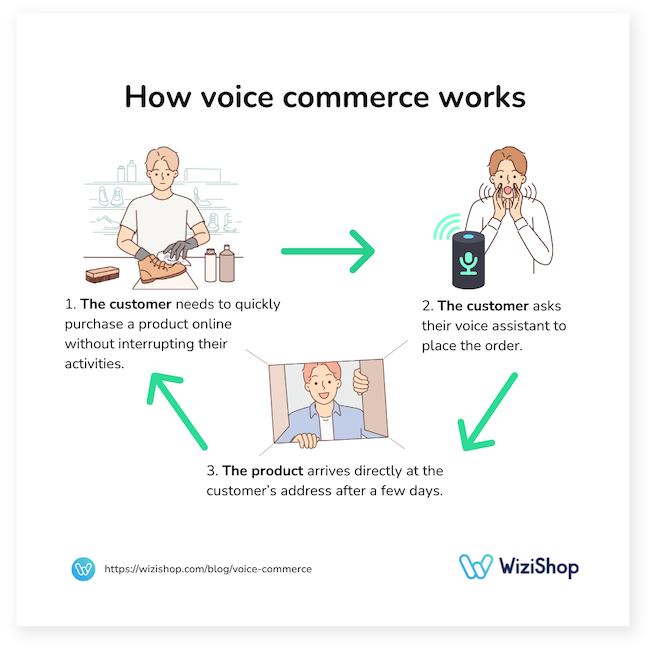
Voice commerce is an integral part of conversational commerce. Buying by talking is becoming a natural gesture, often faster than interacting on a screen, especially if you already know exactly what you want to buy.
For brands, the challenge is to offer a new sales channel that’s integrated into everyday life and capable of facilitating repetitive or low-involvement purchases, such as ordering everyday products, without having to connect to a smartphone or computer screen.
According to Grand View Research, the global market for conversational AI (chatbots, voice assistants, etc.) was estimated at $11.58 billion in 2024, with a forecasted compound annual growth rate of 23.7% from 2025 to 2030.
Example of Cartly, which manages several voice commerce services throughout the entire AI-powered purchase funnel
How does voice commerce work in the purchasing process?
Alexa, Google Assistant, Siri, and their equivalents integrated into apps or connected devices are capable of interpreting long sentences, nuances, preferences, and even the context of a conversation.

With voice commerce, the act of buying becomes almost invisible. But the real game-changer comes from the rise of conversational AI.
Pew Research Center sheds light on the impact of conversational commerce in March 2025 in the United States and shows that approximately 34% of U.S. adults have used the conversational agent ChatGPT.
Thanks to models capable of reasoning, rephrasing, offering personalized recommendations, and anticipating needs, voice shopping is becoming less mechanical and more intelligent, providing an overall better customer experience.
The assistant can do the following:
- remember that a user usually buys a certain product,
- offer an alternative that is on sale, and
- check the availability of an item in real time.
The experience is similar to interacting with a human advisor, while retaining the speed and convenience of digital technology.
At the same time, retail brands are following this ecommerce trend and gradually adapting their catalogs to the requirements of voice search. Better-structured descriptions, enriched data, optimization for “voice SEO,” conversational logic rather than simple keywords... The challenge is no longer just to be found, but to be understood and recommended by a voice assistant!
Even more demanding than traditional SEO, the goal here is to be the one and only answer that best suits the user’s query, whereas with SEO, it’s possible to convert consumers even when ranking only fifth, for example.
Examples of voice commerce strategies
The global report by The Business Research Company forecasts that the voice commerce market will reach $484.09 billion by 2030.
→ To learn more: The future of ecommerce
So what are the striking examples that create such a promise?
Amazon
On Alexa Echo devices, the Amazon account is linked directly to the device, and orders can be placed in a matter of seconds.
With Alexa, for example, I use voice commerce for personal purposes.
My printer is connected to my Wi-Fi network. Alexa is also connected to my Wi-Fi network, and when the system detects that I’m running low on ink, my Echo devices send me a notification asking if I want to buy the right printer cartridge on Amazon.
And just like that, two days later, my cartridge arrives at my doorstep. It’s that simple!
Starbucks
According to an article from USA Today, Starbucks CEO Brian Niccol explained that the company is already testing several uses for AI, from voice control to assisted vision, forecasting, and planning.
The goal is to imagine an experience where you say, “I’ll be there in ten minutes, get my order ready,” and everything is automatically triggered in the store.
Walmart
Walmart leverages voice commerce to make shopping easier and hands-free by letting customers order groceries and other products using voice commands.
Through the integration with voice assistants like Siri and Google Assistant, shoppers can link their Walmart account and simply speak to add items to their cart, reorder frequently bought products, schedule pickup or delivery, and complete their shopping without typing.
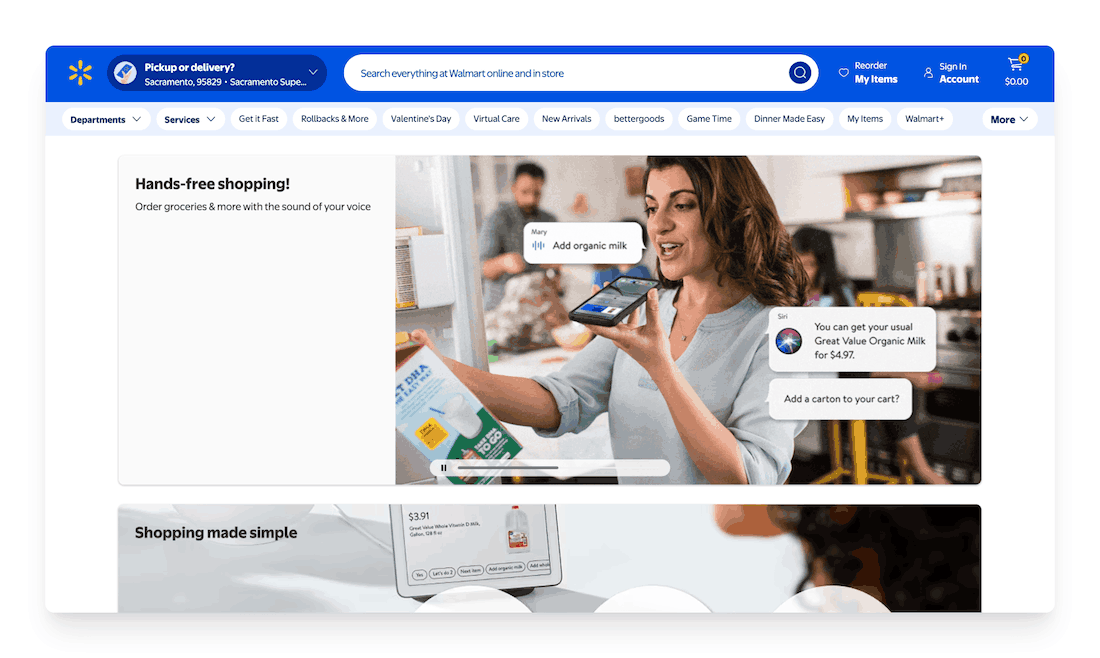
The service is free to use, with charges applied only at checkout, and does not record conversations beyond the trigger words. This voice-enabled experience simplifies everyday shopping tasks and saves time for users.
How can you optimize your ecommerce site for voice commerce?
Optimize your content for voice search
To perform well in voice commerce, your site must learn to speak like your customers.
With voice search technology, internet users no longer type “women's running shoes” into Google, but instead ask “What are the best women’s running shoes for everyday running?”
We’re moving from a keyword to a complete, almost conversational question. And for your business to appear in the answers and reach future customers, your content must follow this evolution.
You need to think about creating content dedicated to these questions and enriching your pages with long-tail expressions that are closer to spoken language (longer sentences, spontaneous phrasing, turns of phrase that resemble a real conversation, etc.).
When it comes to the optimization of your site for voice commerce, your goal is to become the article, product page, or page that exactly answers the question the user asks their voice assistant.
Structure your product data for clear reading
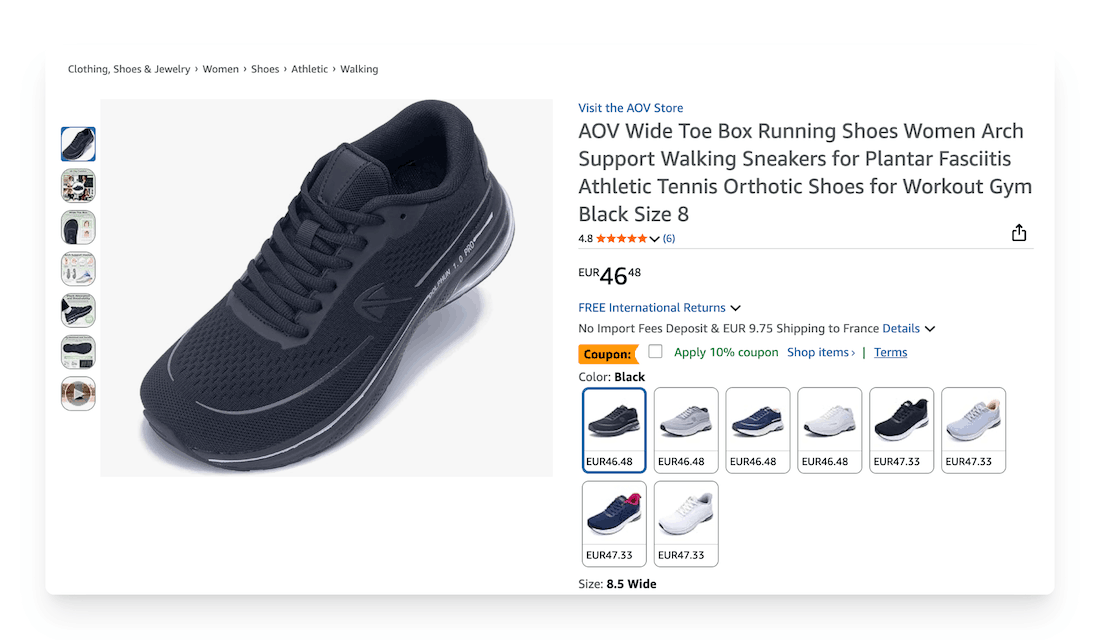
Similar to Amazon product listings, to be recognized in voice commerce, you need to fill in all the data for AI.
For a voice assistant to truly understand what you’re selling, your website must provide it with a language it understands perfectly, namely structured data. Without it, even the best product description remains a vague paragraph that AI will struggle to interpret.
Price, availability, color, reviews, variants... everything is organized and readable for AI.
And there’s a very interesting side effect, because by clarifying your information for the machine, you also improve comprehension for humans.
Streamline the purchasing process to make it compatible with voice
When you buy by voice, you have no screen, no drop-down menus, and no buttons to guide you.
That’s why platforms designed for voice commerce must offer an ultra-simple purchasing journey for the consumer.
A voice assistant cannot handle 10 requests at once, hidden options, or complex processes. It needs perfectly linear logic.
A voice-compatible purchasing journey also means an interface designed for speed (simplified payment, accessible shopping cart, essential information highlighted).
And the clearer the journey is for a human, the more understandable it becomes for AI. That’s why fluidity is one of the best-kept secrets of voice commerce.
Integrate a voice assistant into your website
Adding an AI assistant directly to your website in the form of a chatbot is a bit like offering each visitor a 24/7 advisor who’s ready to answer questions, provide guidance, make recommendations, and sell products.
In the future, a well-integrated voice AI assistant will be able to accompany users from the moment they arrive on the site, understand what they are looking for, suggest relevant categories, explain the differences between two products, or even help them complete their order without friction.
This is the evolution of the simple conversational ecommerce chatbot that we know from the chat bubble at the bottom of pages. With voice, the chatbot will also be able to guide the customer in a voice conversation to the most suitable item for them!
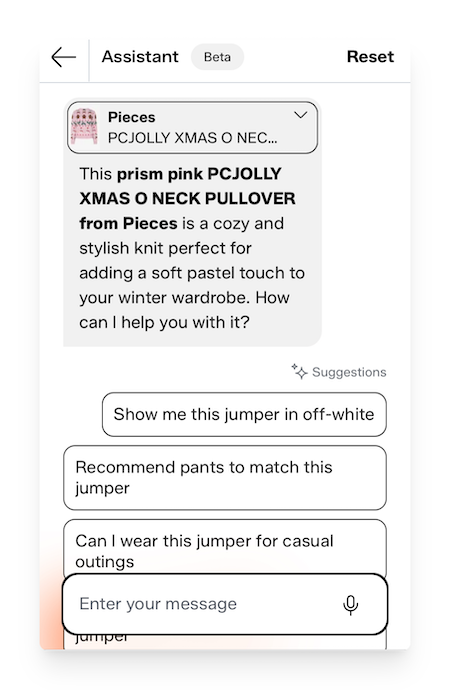
With the help of AI, Zalando is taking customer management to new heights with its smart chatbot. But wouldn’t the next step be to integrate voice AI into the navigation?
Develop your online presence and strengthen your customer reviews
Your online reputation plays a key role in ensuring that your products are interpreted correctly and, above all, recommended by voice assistants.
Conversational AI looks for signs of trust all over the web.
The more your brand is mentioned, the more you become a “reliable” choice in the eyes of a voice assistant, much like SEO in the eyes of traditional search engines.
This is where your online presence comes into play. Mentions on external sites, complete Google business listings, content that gets people talking on social media, and a clear identity all reinforce your credibility.
And of course, customer reviews carry a lot of weight. A well-rated product with detailed reviews is much more likely to be highlighted in a voice response than an item without social proof.
Encouraging your customers to leave reviews, responding to comments, displaying your ratings, soliciting authentic feedback... All of this helps to nurture the ecosystem of trust that surrounds your brand and help convert a potential customer in the future.
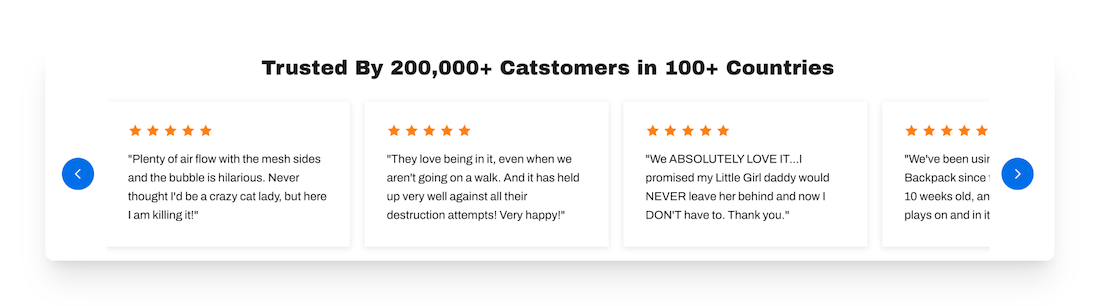
Travel Cat highlights customer reviews on its homepage as well as on each product page.
Talking to your phone or a connected speaker has become as natural as scrolling a page. And behind this simplicity lies a purchasing action that no longer relies solely on keywords or screens, but on a conversation fueled by artificial intelligence.
For e-merchants, success in voice commerce requires content that responds like a human, perfectly structured product data, and a fast, well-designed purchasing process.
Adopting voice commerce isn’t just about adding a futuristic feature to your commercial arsenal; it’s about rethinking the way your customers interact with your brand.
It’s about accepting that in the future, a large part of your ideal customer’s online commerce searches will be done without a screen, in the midst of everyday life, between tasks, at the pace of the immediate needs of increasingly pressed consumers!
And how do you plan to involve the integration of voice commerce into your ecommerce site? I look forward to your feedback in the comments!