


Key points in this article:
- Agentic commerce delegates the entire purchasing process to autonomous AI agents.
- The user expresses a need; the AI searches, compares and pays on its own.
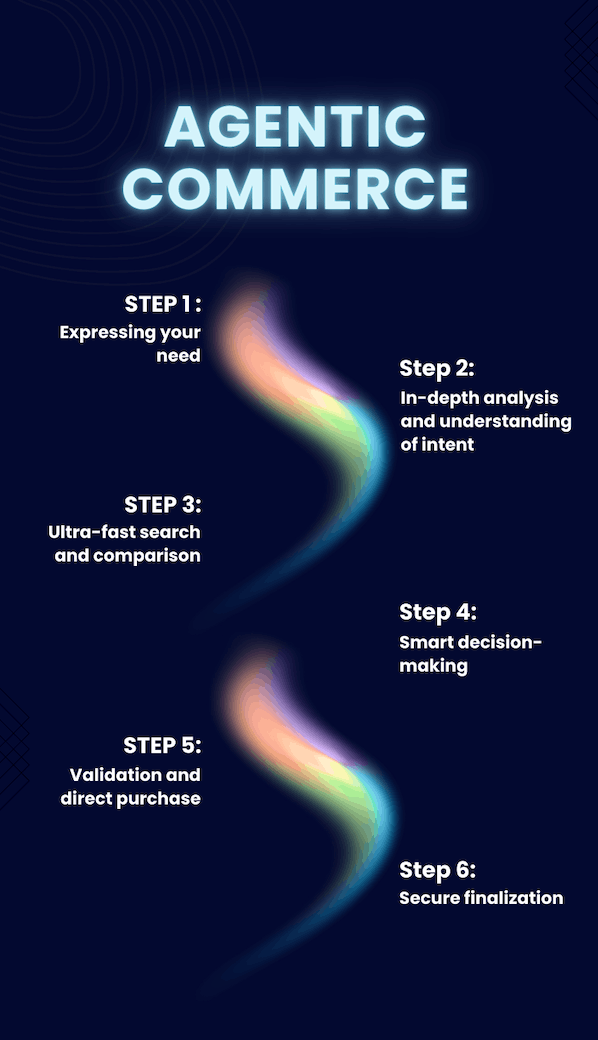
- The process follows six steps: need → analysis → research → decision → validation → finalization.
- Concrete examples already exist: Instant Checkout (OpenAI), Buy for Me (Amazon), Agentic Checkout (Google).
- Merchants must adapt their site to AI agents and adopt open protocols to remain visible.
Agentic commerce, sometimes referred to as a-commerce, is a profound transformation of ecommerce, marking the dawn of a new era in commerce where artificial intelligence completely redefines the shopping experience.
Unlike traditional ecommerce, where the customer controls every step, agentic commerce entrusts these tasks to intelligent agents—autonomous, proactive conversational AI agents.
These agents interpret intentions expressed in natural language, analyze user preferences, explore product catalogs in real time, compare offers according to relevant criteria, choose the optimal option, and finalize the purchase or payment securely.
You’ll find that the result is a seamless, ultra-personalized, and almost imperceptible shopping experience!
This model redefines the relationship between consumers, retailers, and payment infrastructures by placing artificial intelligence at the heart of the purchasing journey and the customer experience.
Are you ready for the future of online shopping, a-commerce style? Let me take you on a journey to understand everything about this experience that is fast approaching around the world!
What is agentic commerce?
Agentic commerce refers to a business model in which AI agents act in place of the user or merchant to automate actions.
This innovation represents a major step forward in the evolution of ecommerce!
→ Our article on ecommerce innovations
This model relies on smart agents powered by artificial intelligence that handle the entire purchasing process on behalf of the user, from analyzing the need expressed in natural language to securely completing the transaction.
Unlike conversational commerce, which is limited to recommendations or reactive assistance, these agents operate autonomously and proactively.
For example, with agentic commerce, you can tell an AI tool,
“Buy me the best organic coffee beans, less than $20, delivered this week.”
The agent takes care of everything, without you having to navigate a website.
The AI does everything for you!

They explore offers on various websites; compare objective criteria (price, availability, delivery times, return conditions); select the optimal option based on the user’s preferences, budget, and buying history; and then execute the payment without further human intervention.
The friction associated with traditional ecommerce is replaced by intelligent anticipation of consumer needs, in complete security.
The experience becomes invisible, as shoppers no longer have to browse, compare manually, or manage administrative steps, including payments.
This model places ultra-personalization and efficiency at the center of the customer journey, with largely automated operations that, although currently causing some apprehension, is quickly going to become the norm around the world.
→ To learn more, check out our article on ecommerce trends.
How does agentic commerce work?
Agentic commerce is comprehensive, delegating 100% of the digital transaction to a funnel where you no longer need to supervise operations.
In practice, however, current agentic commerce still requires human intervention, particularly to validate payment.
It’s already manifesting itself in more advanced forms than traditional ecommerce, with ultra-personalized recommendations based on buying history (size, color, style), or interactions via an intelligent chatbot integrated into the retail business’s site.
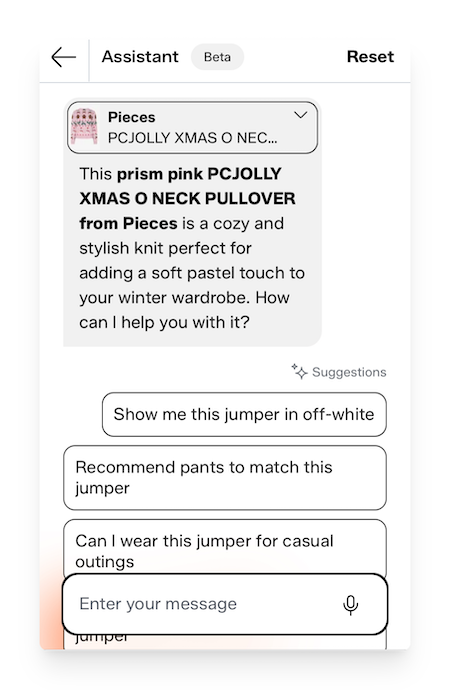
Zalando illustrates this evolution towards agentic commerce perfectly. Its platform integrates a conversational AI assistant that acts as a personal stylist, offers contextual suggestions (weather, occasion, location), and proactively personalizes the shopping experience.
Later in this article, I’ll show you how general AI is already integrating a-commerce!
A six-step process
Here’s how the process works in practice, step by step, using AI that incorporates agentic commerce:
Step 1: Expressing your need
You simply say, aloud or in writing: “Find me a birthday present for my best friend who loves yoga, maximum budget $80, delivery before Friday.” In this case, natural language is sufficient.

Step 2: In-depth analysis and understanding of intent
The AI agent doesn’t simply identify the words “yoga” and “gift,” for example.
It cross-references this request with your buying history, your saved preferences (favorite materials, ethical brands, etc.), your location, and even the context (for a gift, add gift wrapping, delivery must be fast, etc.).
Step 3: Ultra-fast search and comparison
At the same time, the agent simultaneously queries dozens (or even hundreds) of sources: retail sites, marketplaces, price comparison sites, real-time inventory. In a matter of milliseconds, it evaluates the following:
- the most competitive price online (including shipping costs),
- immediate availability,
- actual delivery times and costs,
- return and warranty conditions, and
- the most relevant and recent customer reviews.
Step 4: Smart decision-making
This is something agents aren’t doing yet. In the very near future, the agent will then apply your priority criteria (for example: “always prioritize eco-friendly options,” “never more than 5 days for delivery,” “minimum customer rating of 4.5 stars”).
It ranks the options and selects the one that meets the most criteria, using the buyer’s preferred payment methods and taking into account their usual delivery methods.
Step 5: Validation and direct purchase
Depending on the degree of autonomy you have defined in advance, the agent will either send you a clear proposal and wait for your validation, or proceed directly with your pre-authorized payment method (tokenized card, PayPal account, etc.).
Step 6: Secure finalization
The order is placed, the payment is executed, the delivery method is pre-registered, and you receive a clear summary (summary, tracking number, invoice). Everything is tracked and reversible if necessary.
Differences between ecommerce and agentic commerce
In traditional ecommerce, the user (or consumer) remains at the center of the purchasing process.
The shopper browses websites, manually searches for products, compares offers, reads reviews, adds items to their cart, and completes the payment via a traditional checkout process.
→ To learn more, here is our article on consumer behavior.
In agentic commerce, intelligent agents (or conversational AI agents) act autonomously and proactively on behalf of the user.
They interpret intentions expressed in natural language, analyze user preferences, explore product catalogs in real time, compare prices, availability, delivery times, and conditions, select the optimal option, and then initiate and complete the purchase or payment.
| Main criterion | Traditional ecommerce | Agentic commerce |
|---|---|---|
| User’s role | You control and do everything yourself at every step. | You say what you want; the AI agent does almost everything for you (you only validate if necessary). |
| Product discovery | You search the websites yourself and use the filters. | The AI agent explores websites and catalogs on its own to find what matches. |
| Decision process | You compare, read reviews, and choose for yourself. | The AI agent compares prices, reviews, delivery times, and your preferences, then chooses the best option. |
| Transaction execution | You fill out the forms and confirm the payment step by step. | The AI agent completes the payment automatically (securely, with your prior consent). |
| User experience | You see all the pages and have to click several times. | It’s quick and easy: you just receive a final confirmation. |
| Level of personalization | Suggestions basées sur vos achats passés | The AI agent knows your tastes and adapts constantly. |
| Security and trust | You check the site and decide if you trust it. | The AI agent applies strict rules against fraud to protect you. |
| User effort required | Lots: search, compare, pay | Very little: you give the order and the AI agent takes care of the rest. |
Examples of agentic commerce
OpenAI – Instant Checkout
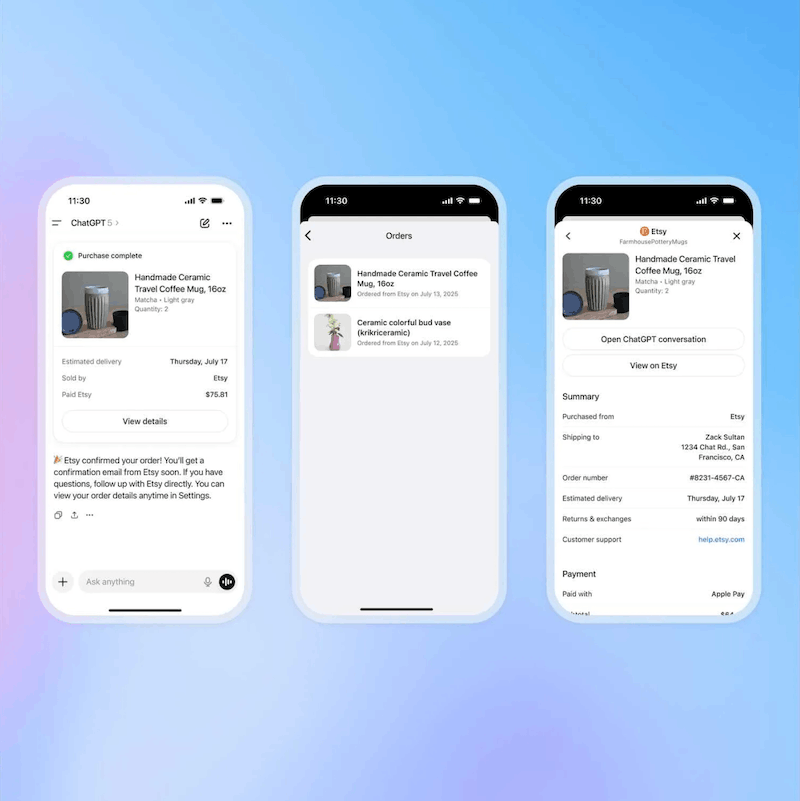
Integrated directly into the ChatGPT interface, the Instant Checkout feature allows users to complete a purchase without ever leaving the conversation.
Simply express a need (“I'm looking for a waterproof backpack for hiking, around $100”) and the AI agent will search, compare, and offer an immediate buying option.
As of January 2026, Instant Checkout is mainly available in the United States for users of ChatGPT’s Free, Plus, and Pro plans.
→ Learn more about ecommerce in the USA.
Amazon – Buy for Me
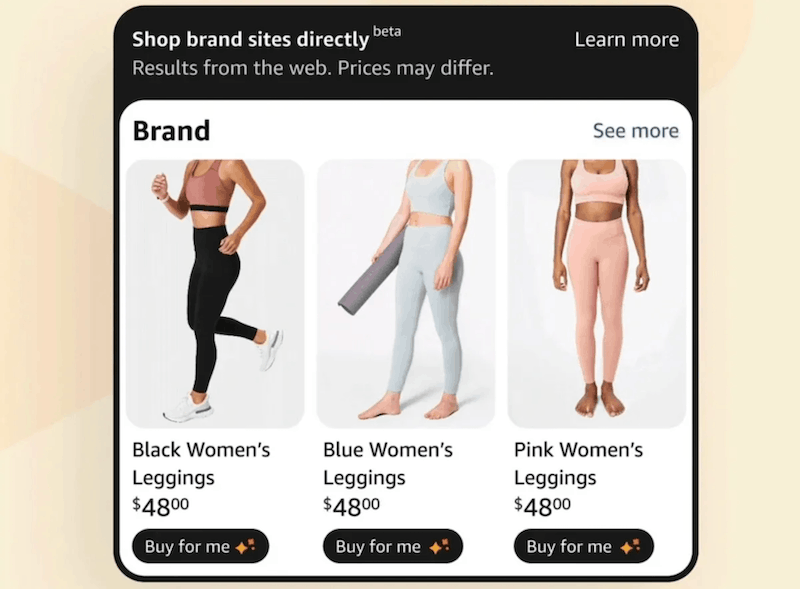
Introduced in April 2025, the Buy for Me feature transforms the Amazon app into a true autonomous shopping assistant.
The user specifies their needs, and the AI agent searches not only the Amazon catalog of products but also third-party seller sites, validates the order, and manages the entire payment and delivery process without the user ever leaving the Amazon ecosystem.
Google – Agentic Checkout (AI Shopping Mode)
Spectacularly unveiled at the NRF trade show in January 2026, Agentic Checkout is integrated into the Gemini and Google Search interfaces.
It allows users to track price changes in real time and can help trigger purchasing at the optimal moment (for example, when the price reaches a historic low or stock is likely to run out).
In January 2026, the initial rollout focused on the United States, with a gradual expansion to other markets.
Other initiatives
Several other players are actively contributing to the agentic commerce ecosystem:
- Perplexity – Buy with Pro: this feature enables fully conversational shopping within the Perplexity search interface, with real-time comparison and direct checkout.
- Microsoft Copilot Checkout: extension of the Copilot assistant enabling complete buying journeys, with Stripe and PayPal integrations, already deployed in the United States, with international extensions in progress.
How can you prepare your ecommerce business for agentic commerce?
Accessibility for AI agents
Merchants who choose to implement these protocols early on will see their chances of being selected and prioritized by agents increase significantly!
The first requirement for existing in the world of agentic commerce is to make your store accessible and readable by systems that don’t navigate like humans.
For example, when a product goes out of stock in its blue version, your infrastructure must propagate this data instantly so that AI agents have the most recent version of the catalog.
In the short term, technical optimization of the site in “ultra-readable” mode is already producing positive results in a-commerce. Ensure that your pages load quickly, that your HTML code is clean, and that your robots.txt file explicitly authorizes the user agents of the main agents and platforms (e.g., those of OpenAI, Google Gemini, or Perplexity).
In the medium term, standardized open protocols will need to be adopted. Among the most mature standards adopted in 2026 are the following:
- Agentic Commerce Protocol (ACP), co-developed by OpenAI and Stripe, already in production (notably via Instant Checkout in ChatGPT). It enables secure flows between agents, buyers, and merchants for transactions that are already secure.
- Universal Commerce Protocol (UCP), launched by Google in early 2026 in collaboration with Target, Walmart, Etsy, and others, and supported by more than 20 partners (such as Adyen, Stripe, and Visa). It covers the entire journey: discovery, shopping cart, payment, and post-purchase.
- Agent Payments Protocol (AP2), initiated by Google with more than 60 partners (Mastercard, PayPal, Adyen, etc.), focused on securing digital transactions and tracking agent-initiated payments.
Merchants who integrate this new wave of protocols ahead of the competition are more likely to be selected and prioritized by agents and thus secure a privileged place in future online purchasing options offered by AI.
Clear and up-to-date product information
Artificial intelligence agents behave like emotionless comparison tools. They are, above all, robots!
They extract only measurable facts and instantly compare them with hundreds of other items featured in the digital catalogs of competing businesses.
Thus, an incomplete, ambiguous, or outdated product listing disqualifies your retail business’s site before the comparison even begins!
Your product information is key: write detailed descriptions, organized logically with clear headings, themed paragraphs, comparison tables, and technical lists.
Always include the attributes most valued by agents (exact material composition, product labels, precise dimensions, actual weight, battery life, etc.).
To help make it as readable as possible, you should also include structured data.
Here are the main types of structured data to implement as a priority when preparing your ecommerce site:
- Product: to describe the product itself (name, brand, description, image, etc.).
- Offer: to indicate the price, currency, and availability (in stock or not).
- AggregateRating: to group ratings and the number of customer reviews (e.g., 4.3/5 based on 127 reviews).
- Review: to detail individual reviews if you wish.
- Availability: to clearly specify whether the product is available, on pre-order, etc.
- ShippingDetails: to explain shipping costs, delivery times, and areas covered.
- ReturnPolicy: to indicate the return conditions in a precise and machine-readable manner.
Note that they’re added automatically on our WiziShop solution.
SEO optimizations designed for AI
Being promoted by artificial intelligence dedicated to shopping means being well referenced in AI pipelines in general.
SEO optimized for artificial intelligence should be one of your priorities in order to stay ahead of the game in AI shopping.
Keywords, internal tags, page structure... As we’ve just seen, these optimizations are essential, but that’s not all.
Customer reviews are a particularly powerful lever: their volume, recency, ratings according to criteria, and authenticity strongly influence the weighting of agents in favor of your brand.
Regarding optimization for agent engines (AEO or Answer Engine Optimization), it’s based on simple practices closely related to traditional SEO:
- Use the words and phrases that consumers use in their searches naturally and accurately.
- Include questions in a FAQ section that’s well structured.
- Provide size guides in the form of readable text or easy-to-understand tables.
Brand awareness
In this new way of selling online, agentic commerce imposes new rules for online brands.
When faced with two similar offers, artificial intelligence agents systematically favor the best-known, most transparent, and most reliable brands.
Brand awareness and trust thus become active and decisive selection criteria for automated purchases.
On your website or blog, publish a dedicated page clearly explaining how your ecommerce site handles purchases initiated by artificial intelligence: payment commitments, consent, complete transaction traceability, enhanced anti-fraud policy, proactive dispute management.
The icing on the cake is to create educational content about your brand and products to appeal to artificial intelligence. Blog articles, practical guides, short explanatory videos... Agents value businesses that inform and reassure consumers!
And as with any good SEO strategy, collect quality mentions and backlinks on specialized media, influential blogs, and professional forums to help raise your trust score with agents.
With agentic commerce, everything happens automatically, thanks to agents that act proactively and strictly follow pre-programmed instructions. While this autonomy may currently raise legitimate questions about trust and security, it’s quickly becoming the dominant norm in agentic commerce, transforming the promise of agentic commerce into an everyday reality for customers and consumers.
Today, agentic commerce isn’t yet fully developed everywhere around the world, but it likely won’t be long before it is.
So, from now on, consider artificial intelligence not as a distant threat, but as a fully-fledged omnichannel channel that’s redefining the consumer shopping experience.
Companies that invest in these preparations starting in 2026 will build a sustainable competitive advantage that will be difficult to overcome later.
And we at WiziShop will always support you in the development of these future ecommerce technologies!



BestPhotos le 7 April 2026 à 23:09