

Key points in this article:
- Social commerce will reach a scale comparable to that of traditional ecommerce by 2026 thanks to direct purchasing integrated into social networks.
- Live shopping is emerging as a major lever by combining live demonstration, immediate interaction and instant conversion.
- Generative engine optimization (GEO) is becoming essential to be recommended or cited by conversational AI assistants.
- Agentic commerce transforms ecommerce into a journey entirely managed by autonomous AI agents based on a simple expressed need.
- The subscription model is intensifying significantly, becoming the main source of recurring revenue and customer loyalty in apps.
Digital marketing is constantly evolving.
New changes appear month after month: new social networks emerge, innovative technologies powered by artificial intelligence and augmented reality arrive in our lives, search engine algorithms become more powerful and intelligent, and internet users interact more and more with AI such as Gemini and ChatGPT.
All these advances are causing an explosion in new online practices among internet users and, as a result, in the way retailers, brands, and companies need to communicate with their audience, customers, and consumers.
Major developments in digital marketing are helping to advance companies’ sales and marketing strategies for ever-increasing revenue and customer loyalty.
In other words, to stay competitive and up to date with your ecommerce site, it’s essential to keep abreast of the latest digital marketing trends and anticipate developments dictating the future of content marketing.
What are the major trends for 2026 that you should not ignore in your strategy?
Table of contents
- 1. Social commerce’s importance being equal to that of traditional ecommerce
- 2. The live shopping craze
- 3. Generative engine optimization (GEO)
- 4. Traditional ecommerce vs. agentic commerce
- 5. Intensifying subscription economy
- 6. Unexpected collaborations between brands
- 7. Even more precise customer service with AI-powered automation
- 8. Augmented reality for trying products anywhere
1. Social commerce’s importance being equal to that of traditional ecommerce
Social commerce involves integrating purchasing directly into the social media experience. Users discover, browse, and buy products without ever leaving the platform!
→ Read our full article on social commerce.
Brands are no longer content to promote their offerings on their dedicated e-commerce sites, but are taking full advantage of the native shopping features of social platforms to generate revenue directly in-app.
Internet users browse, compare, interact, and complete their purchases without leaving the app, creating a frictionless journey that maximizes conversion by capturing intent at the precise moment it arises.Most major networks now have advanced shopping tools:
- Instagram Shopping with its product tags in posts, Reels, and Stories;
- TikTok Shop, which dominates growth thanks to its discovery algorithm and live streams; and
- Pinterest for visual inspiration and shopping pins.
Projections confirm this growth: the global social commerce market will reach approximately $2.11 trillion in 2026 (with a compound annual growth rate of 29%, according to recent analyses by Mordor Intelligence).

2. The live shopping craze
Given the popularity of social shopping among internet users, as we have just seen, and the video format, live shopping is emerging as one of the most dynamic and effective levers in digital marketing.
In digital marketing, this hybrid format, which combines live demonstrations, real-time interaction, and immediate purchasing by the user, is radically transforming the customer and user experience by bringing them closer to the immediacy and conviviality of physical commerce.
In short, it’s a new generation of teleshopping!
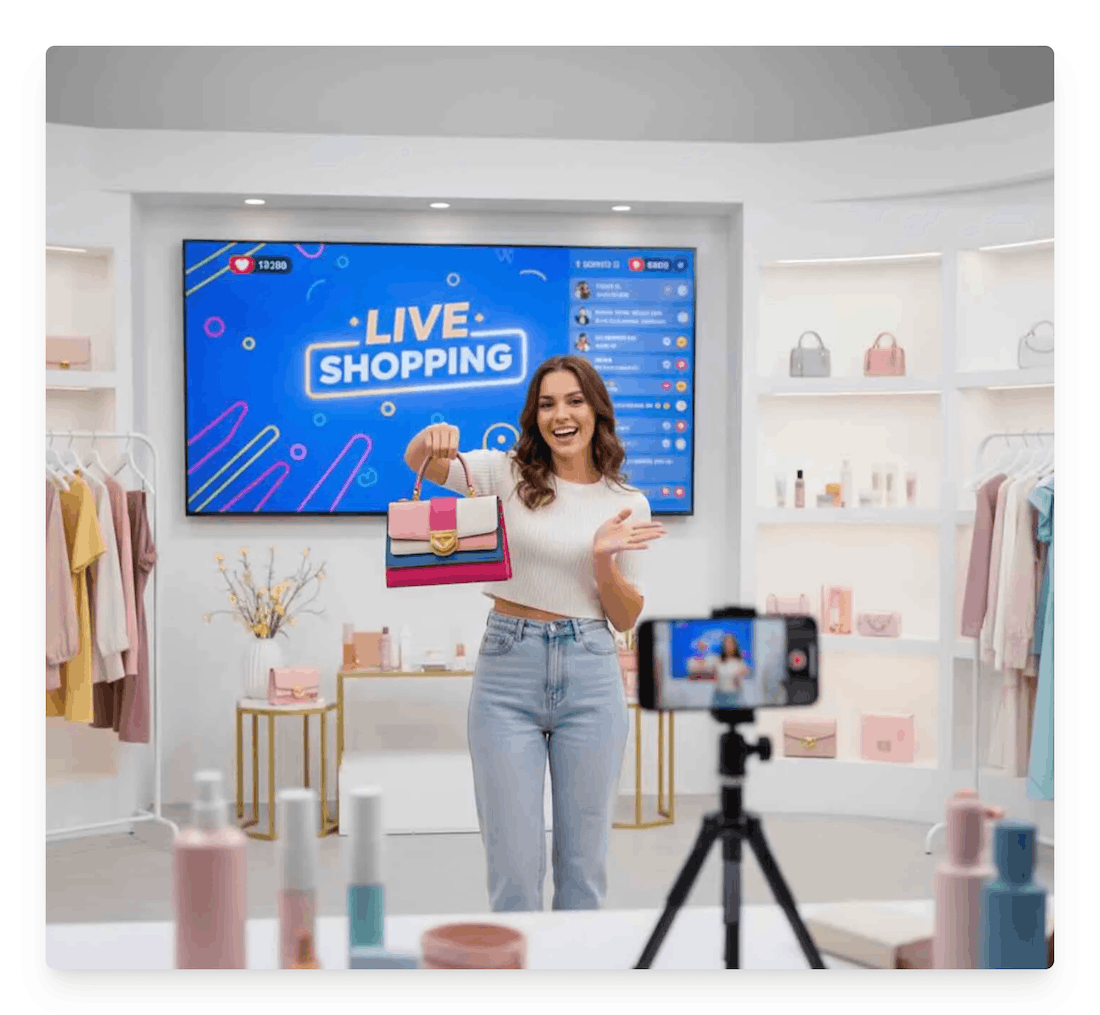
Consumers and customers ask questions, get instant answers from the presenter (often an influencer, expert, or company representative), take advantage of exclusive limited-time offers, and complete their orders without leaving their favorite platform.
Here, you can see highlights from a YouTube live shopping event by the company Nordstrom.
Source: Nordstrom on YouTube
Among the favorite social platforms of marketers and brands:
- TikTok Shop continues to dominate thanks to its powerful algorithm and massive reach.
- Whatnot excels in niche markets and the sale of specialized product collections.
This marketing trend brings the internet closer to in-store sales processes: internet users observe the product in context, discover its details in motion, hear live reviews, and enjoy human interaction that dispels any doubts.
→ Read also: Ecommerce marketing trends
3. Generative engine optimization (GEO)
AI is everywhere.
With the widespread use of AI assistants such as Grok, Gemini, Perplexity, ChatGPT, and Claude, digital visibility strategies are undergoing profound changes in 2026.
In this context, generative engine optimization (GEO) is emerging as an integral part of traditional SEO. It aims to obtain citations, mentions, and recommendations directly in AI responses.
Gartner predicts a 25% decrease in the volume of traditional search by the end of 2026 , in favor of AI interfaces which are becoming the main entry point for information search and purchases.
Being cited, recommended, or reliably and positively summarized in these responses is becoming a strategic objective.
The goal today is to be on the first 10 pages of Google, have an online presence, and also appear in LLMs (large language models), based on the user’s specific search queries.

4. Traditional ecommerce vs. agentic commerce
What is agentic commerce? It’s ecommerce fully assisted by AI.
The consumer expresses a general need (“I’m looking for a designer vase for less than $100”), and the agent manages the entire process, searching for the best deals, the most suitable products, and even handling the logistics.
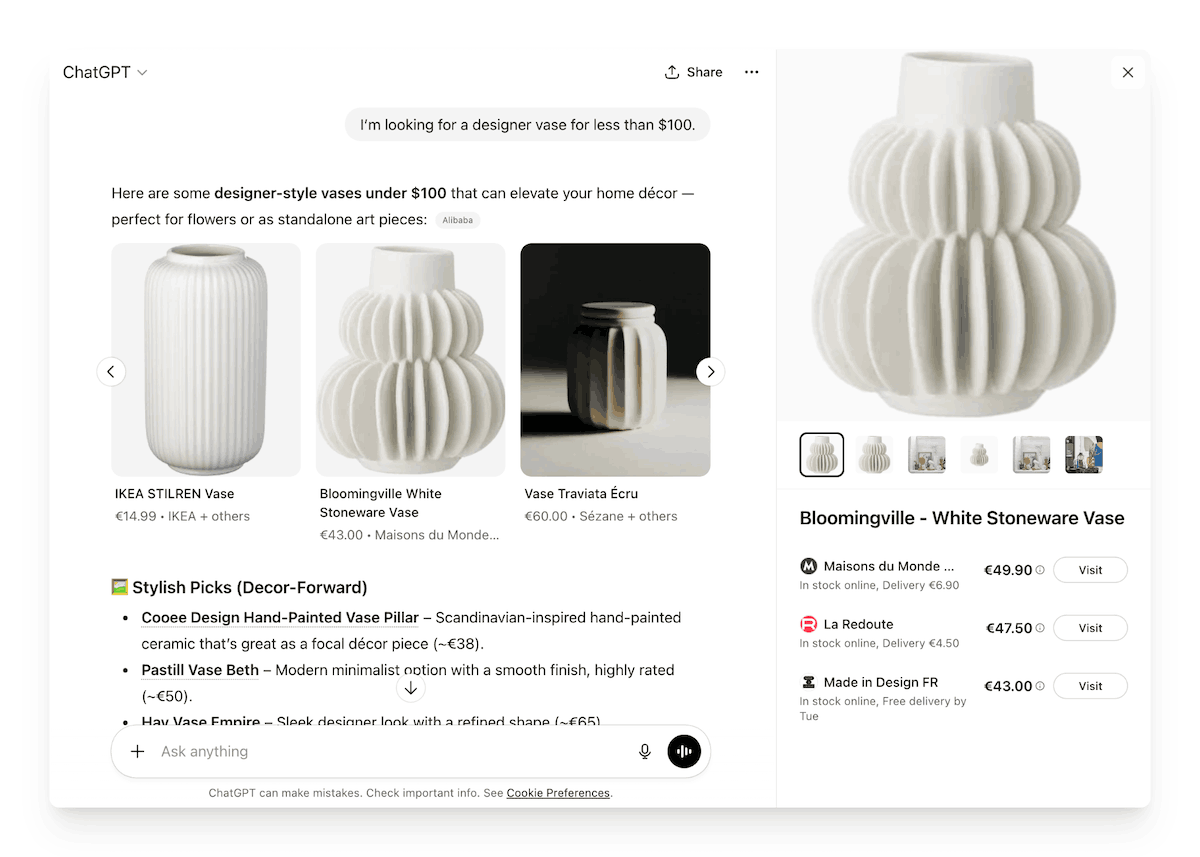
The global market for autonomous AI agents is experiencing explosive growth, with projections reaching up to $14.25 billion by 2026 (according to The Business Research Company), representing a major transition to systems capable of independently performing complex actions.
Major initiatives, such as Google’s Universal Commerce Protocol (UCP) (with partners like Etsy, Walmart, etc.), allow AI agents to make purchases directly from interfaces like Google Search or Gemini, without leaving the conversational environment.
→ To learn more, see our article on conversational commerce.
Similarly, protocols like OpenAI’s Agentic Commerce Protocol (ACP), integrated with ChatGPT, facilitate instant payments (when the initial store allows it), personalized and proactive recommendations, and above all, a seamless experience throughout the entire purchasing journey.
These ecommerce innovations are redefining digital marketing strategy and conversational marketing by placing artificial intelligence at the heart of the interaction with consumers.
McKinsey estimates that AI agents could bring in between $3 and $5 trillion in global retail revenue by 2030, which proves the scale of this ongoing transformation!
→ For your ecommerce business, this trend, linked to GEO, requires adopting best practices to prepare your store for these changes. Find our advice in the article on agentic commerce.
5. Intensifying subscription economy
In the mobile app landscape of 2026, the subscription model has become the primary source of monetization, offering unlimited or near-unlimited access to all in-app resources and features.
This mechanism, based on recurring payments (monthly, annually, or sometimes weekly), allows users unrestricted access to the entire catalog of content, tools, and services offered by the app, after a free trial or limited version.

This model contrasts with traditional approaches based on one-time purchases or intrusive online advertising. Users pay for a service that is constantly enriched, regularly updated, and tailored to their evolving needs.
It’s a model that social networks are trying to implement (such as on Instagram and case-by-case subscription systems).L
Market data indicates that more than 80% of non-gaming app revenue comes from premium subscriptions, according to Statista.
Some examples of subscription-based products:r
- Streaming apps: Deezer, Spotify, Netflix, YouTube
- Educational and learning apps: Duolingo, Udemy
- Wellness and health apps: Headspace, Calm, Strava
In ecommerce, you can develop a subscription offer to build customer loyalty and offer exclusive content: for example, a maintenance service for the products you sell, beauty services (makeup, massages, etc.) using the products you have in your store, a monthly box of products sent to the customer, and more.m
There are lots of ideas out there, and it’s up to you to figure out how you can generate recurring revenue!
6. Unexpected collaborations between brands
A probiotic yogurt for children suddenly teams up with the world’s most iconic game, the one where you build worlds pixel by pixel. That’s exactly what happened with Actimel Kids and Minecraft!

Far from being an isolated incident, this illustrates a powerful wave sweeping through ecommerce marketing, namely partnerships and collaborations between brands. And the most unlikely alliances are becoming the most memorable!
The luxury sector has already embraced this concept, often with completely unconventional products, as seen here with the collaboration between Crocs and Balenciaga. If the goal is to generate buzz for the brand, it's certainly been achieved!

This year, brands are daring to break the boundaries of their usual world to create surprise, emotion, and above all, viral engagement.
These unexpected partnerships no longer simply put a logo on a product; they tell a story, merge two cultures, and generate organic buzz that traditional campaigns struggle to match.
Why is this phenomenon exploding in 2026? Because consumers, saturated with traditional ecommerce advertising messages, respond enthusiastically to originality and perceived authenticity.
A well-thought-out collaboration instantly broadens each partner’s audience, reaches new generations (particularly gamers and new generations of buyers), and creates a sense of exclusivity around limited editions or original customer experiences.
For companies, the challenge is to identify complementary worlds, even the most surprising ones, and build partnerships that go beyond the simple product by imagining the entire ecosystem around the brand (video games, social networks, contests, etc.).
7. Even more precise customer service with AI-powered automation
Chatbot responses have never been so personalized.
In 2026, customer service will no longer be satisfied with just responding quickly: customer service must understand, anticipate, and reassure, almost like a store advisor who already knows the customer’s tastes and history.
This is exactly what AI-driven hyper-automation enables.
It combines ultra-intelligent conversational agents, cutting-edge natural language processing, predictive analytics, and seamless process orchestration to handle the majority of requests without human intervention... while maintaining a natural and empathetic tone.
Let’s take an example of what could happen in ecommerce: a customer writes to you at 10 p.m. because the dress she ordered for a wedding is late. Instead of a standard automated message, here’s what happens in a matter of seconds:
- The AI tool reads the message and detects the urgency.
- It immediately checks the order status, the carrier’s tracking information, and the customer’s history.
- It checks whether a commercial gesture is possible according to your rules (discount, credit note, alternative express delivery, etc.).
- It responds with a warm and personalized message: “I understand that this is stressful with the wedding just a few days away... I’ve just checked, and the package is stuck with the carrier, but I’m sending you a $30 voucher right now to help you find a last-minute solution.”
- She creates the credit note, sends it by email and text message, updates the ticket, and leaves you a clear summary in the back office in case the customer calls back.
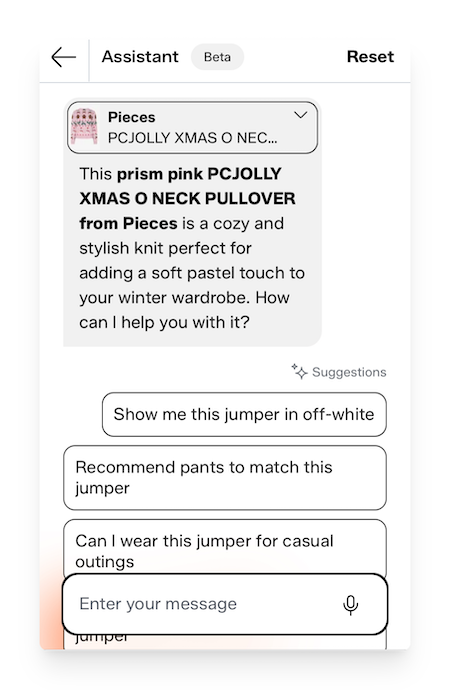
Traditional chatbots are tending to develop these ultra-personalized technologies, which will soon become the norm, as seen here in beta on the Zalando website!
8. Augmented reality for trying products anywhere
In 2026, augmented reality (AR) has established itself as one of the most powerful tools in digital marketing and ecommerce trends, bridging the gap between online shopping and the in-store experience.
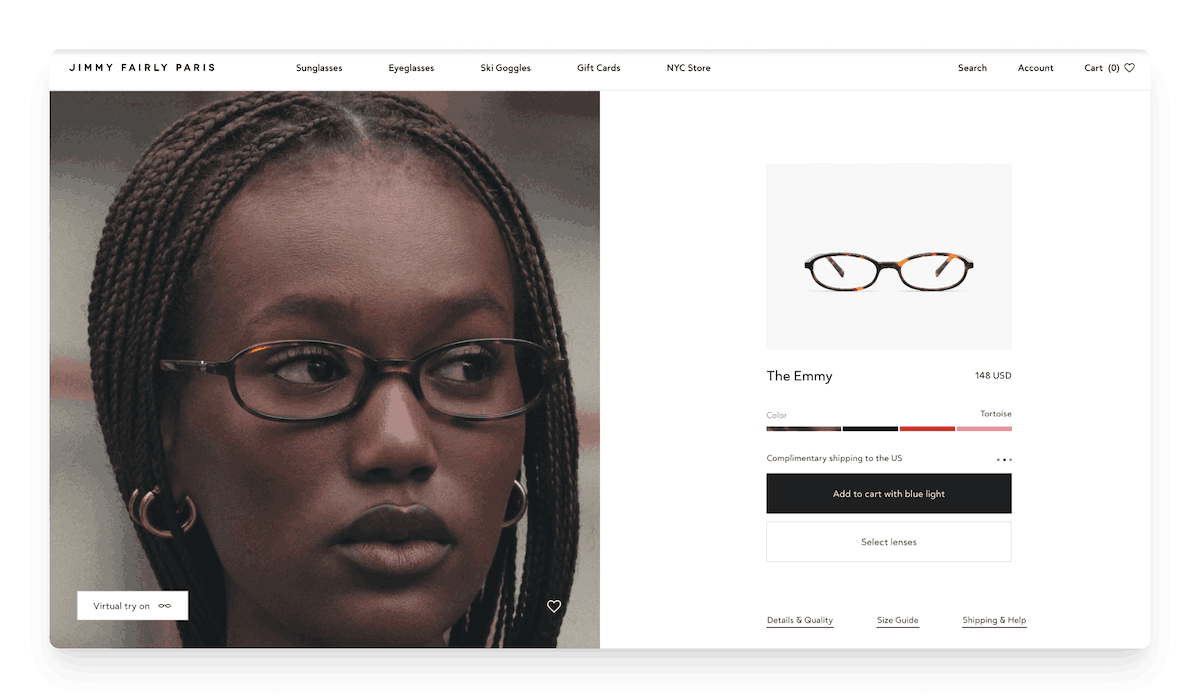
Using the camera on their smartphone or tablet, consumers and customers can now virtually try on clothes, glasses, makeup, and jewelry, or view furniture and decorative items in their own environment at actual size, without having to leave home, as shown here with Jimmy Fairly.
Brands and companies that choose augmented reality technologies and artificial intelligence in their digital marketing strategy are revolutionizing the customer journey.
Virtual try-on, available anytime, anywhere, eliminates hesitation related to size, color, or how a product will fit in a real space, as seen with IKEA, for example.

It thus offers a seamless experience and a customer experience (or even a user experience) that is much closer to the tactile sensation of a traditional store.
The AR market in retail and ecommerce continues its exponential growth in 2026, driven by new trends in digital marketing and artificial intelligence-related marketing.
Today’s consumers are increasingly demanding, better informed, and less patient. It’s no longer enough to follow your customers; you now have to anticipate everything, surprise them, and reach them exactly where they are.
In 2026, creating strategic content for ecommerce will be a top priority. Every publication and every digital experience must converge toward a clear goal, which is to capture attention at the right moment and turn that attention into conversion.
The time has come to reassess your online priorities. Are you ready to turn these changes into a competitive advantage and make your online business a long-term success?
Let me know in the comments if you’re already using any of these strategies and how they benefit you on a daily basis!